Laboratory Tests Before Testosterone Therapy: What Men Should Know

Updated: Sep 14
Written by the Innovative Men's Health Editorial Team
Medically reviewed by Alessa Lopez-Castor, ARNP, DNP
Last medically reviewed: September 9, 2026
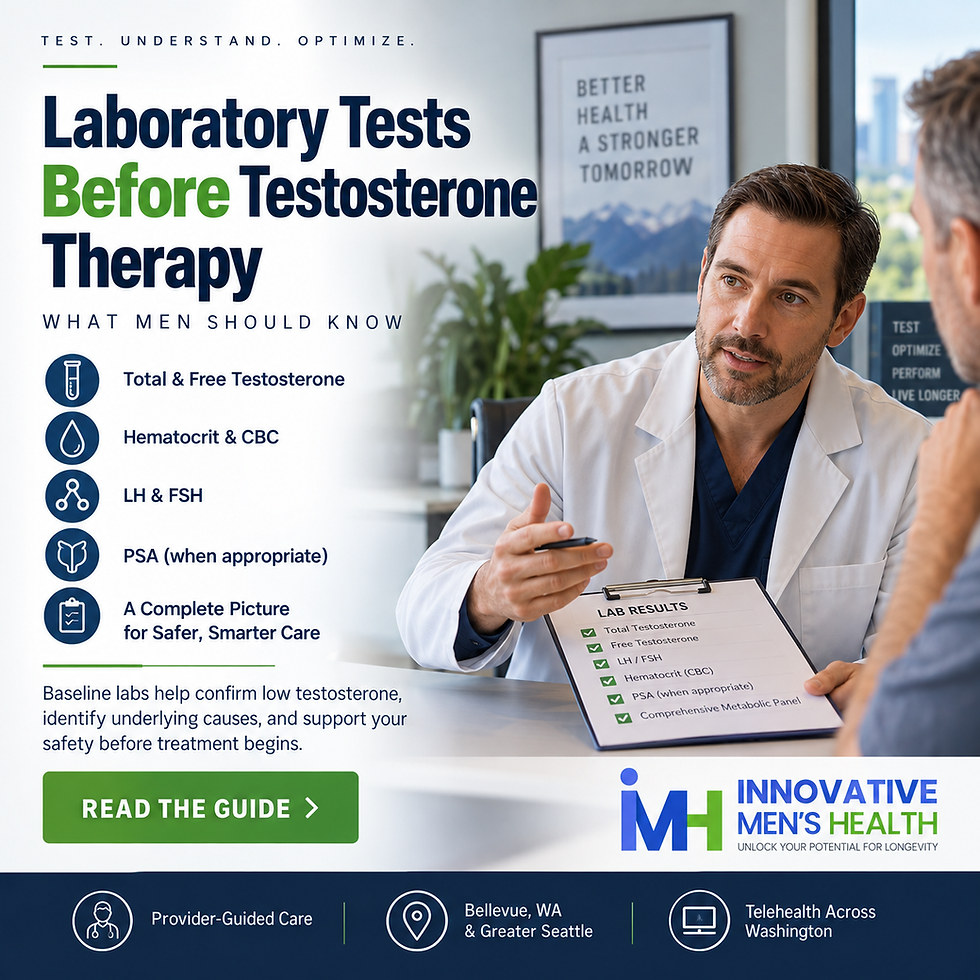
If you're considering testosterone replacement therapy, laboratory testing is one of the most important parts of a proper evaluation.
Baseline labs can help a licensed medical provider determine whether low testosterone is actually present, look for clues about why testosterone levels may be low, and identify health factors that should be considered before treatment begins.
A responsible evaluation goes beyond a single testosterone number. Symptoms, medical history, appropriately timed laboratory testing, and follow-up testing when indicated all contribute to the clinical picture.
This guide explains the laboratory tests commonly reviewed before testosterone therapy and what each can help a provider understand.
WHY BASELINE LABS MATTER BEFORE TRT
Testosterone therapy is considered for men with symptoms or signs consistent with testosterone deficiency and laboratory confirmation of low testosterone — not a single low number and not symptoms alone.
Baseline testing also supports safety. Certain findings, including an elevated hematocrit, may need to be evaluated before therapy is started. Prostate risk assessment and PSA testing may also be appropriate depending on age and individual risk.
LABS START WITH THE CLINICAL PICTURE
Bloodwork follows a conversation. A provider-guided evaluation may review energy, libido, erectile function, mood, sleep, weight changes, medical history, medications, and other conditions that can affect hormone levels.
Timing matters. Testosterone testing is generally performed in the morning, when levels are typically highest.
LABORATORY TESTS BEFORE TESTOSTERONE THERAPY
Total testosterone is the cornerstone baseline hormone test. It measures the testosterone circulating in the blood, including both bound and unbound hormone.
Guideline-aligned evaluation commonly includes:
• Morning testing. Testosterone is generally measured in the morning.
• Confirmation. Testosterone levels fluctuate, so clinicians often repeat the test in the morning to confirm a low result.
• Clinical context. A laboratory number alone does not diagnose testosterone deficiency. Symptoms and medical history matter too.
FREE TESTOSTERONE AND SHBG: WHEN INDICATED
Most testosterone in the bloodstream is attached to proteins, particularly sex hormone-binding globulin (SHBG) and albumin. Free testosterone is the smaller portion that is not bound to protein.
Free testosterone may provide additional information when total testosterone is near the lower end of the reference range or when conditions affecting SHBG could make total testosterone less informative. It is not necessarily required for every patient.
LH AND FSH: LOOKING FOR WHY TESTOSTERONE MAY BE LOW
When testosterone is confirmed to be low, luteinizing hormone (LH) and follicle-stimulating hormone (FSH) can help a provider determine whether the issue may originate primarily in the testes or higher in the hormonal signaling system involving the pituitary and hypothalamus.
That distinction can affect whether additional evaluation is appropriate.
HEMATOCRIT AND CBC BEFORE THERAPY
A complete blood count (CBC), including hematocrit, is an important safety check before testosterone therapy.
Testosterone can increase red blood cell production. Knowing a patient's baseline hematocrit allows the provider to identify an elevated level before treatment and provides a comparison point for future monitoring.
If hematocrit is already elevated, the cause may need to be evaluated before testosterone therapy is started.
Considering Testosterone Therapy?
Lab results are only one part of the picture. Learn how Innovative Men’s Health evaluates symptoms, medical history, laboratory results, and treatment options.
PSA AND PROSTATE RISK ASSESSMENT WHEN APPROPRIATE
PSA testing and prostate risk assessment may be appropriate for men considering testosterone therapy depending on age, history, and individual risk.
An elevated PSA or other concerning finding may require additional evaluation before treatment proceeds.
OTHER LABS MAY BE CONSIDERED
Depending on medical history, symptoms, and initial results, a provider may consider additional testing such as:
• Prolactin or other pituitary-related testing
• Glucose or other metabolic markers
• Lipid testing
• Other hormone or organ-function testing when clinically appropriate
No single universal laboratory checklist applies to every man. Testing should be individualized.
WHAT PATIENTS CAN EXPECT AT INNOVATIVE MEN'S HEALTH
At Innovative Men's Health in Bellevue, evaluation for testosterone therapy is provider-guided and based on symptoms, medical history, and appropriate laboratory testing — not a single number or an online quiz.
Eligible patients throughout Washington may also access telehealth when clinically appropriate.
A typical evaluation may include a focused consultation, appropriately timed laboratory testing, review of the results in context, and a discussion about whether treatment is appropriate and what ongoing monitoring may involve.
KEY TAKEAWAYS
• Testosterone deficiency is evaluated using symptoms or signs together with consistently low testosterone levels.
• Morning total testosterone testing is a foundation of the evaluation, and a second measurement is commonly used to confirm a low result.
• Free testosterone may be useful in selected situations.
• LH and FSH can help clarify why testosterone may be low.
• CBC and hematocrit provide important baseline safety information.
• PSA and prostate risk assessment may be appropriate depending on age and individual risk.
• Additional testing depends on the individual patient.
FREQUENTLY ASKED QUESTIONS
Do I need fasting labs before testosterone therapy?
Many clinicians prefer morning testing, and fasting may be requested depending on the tests being ordered. Follow the instructions provided by your medical provider.
Why is a second testosterone test common?
Testosterone levels naturally fluctuate. Confirming a low result with another appropriately timed measurement helps provide a more reliable clinical picture.
What is the difference between free and total testosterone?
Total testosterone includes both protein-bound and unbound testosterone. Free testosterone is the unbound portion and may provide additional information in selected situations.
Is hematocrit checked only before TRT?
No. Hematocrit is commonly reviewed before therapy and monitored during treatment because testosterone can increase red blood cell production.
Does every man need a PSA before TRT?
Not necessarily. Whether PSA testing or additional prostate evaluation is appropriate depends on factors such as age, medical history, and individual risk.
READY TO TAKE THE NEXT STEP?
If you have questions about your symptoms or testosterone levels, start with a provider-guided evaluation at Innovative Men’s Health.
SOURCES
Endocrine Society — Testosterone Therapy in Men With Hypogonadism:https://www.endocrine.org/clinical-practice-guidelines/testosterone-therapy
American Urological Association — Testosterone Deficiency Guideline:https://www.auanet.org/guidelines-and-quality/guidelines/testosterone-deficiency-guideline
MedlinePlus — Testosterone Levels Test:https://medlineplus.gov/lab-tests/testosterone-levels-test/
MEDICAL DISCLAIMER
This article is for educational purposes only and does not provide medical advice, diagnosis, or treatment. It does not establish a patient-provider relationship. Always consult a licensed medical provider about your symptoms, laboratory results, and whether testosterone therapy is appropriate for you.


Comments